More of The Guardian, website expenditure, crowdsourcing visualisations and THAT Birmingham City Council website…

Since last week’s blog post, the Guardian, having had the data thrown their way by a couple of freelance journalists at Peopleperhour, have made the website expenditure across all the UK councils public and the data is now available online.

It’s a shame that the link to the Guardian’s Manyeyes visualisation is a broken one, but it’s interesting that they have thrown data out to the audience to crowdsource visualisations and host them on their own Flickr group.

It’s a great chance to play around with a goldmine of data that is both contemporary and relevant, and there are some great examples up already.

So, to summarise, every council’s spending on websites is up there, and ten have spent over £100,000, including the over-exuberant Birmingham City Council, pushing way out in front with £2,800,000. And the data is all there  for you to use.

The Birmingham.gov controversy, as told by The Telegraph…

Sometimes, it?s nice to sit back and read through the results of a hugely successful investigation. Even nicer when we kicked the whole thing off.

The Telegraph online reported on Monday that ?councils are spending millions on redesigns of their websites despite facing the biggest funding cuts in their history?, with a story originating from a Helpmeinvestigate investigation into the Birmingham City Council website renovation.

The proposed website renovation had been announced in 2007 but was nowhere to be seen until 2009, and was supposedly being outsourced by private hire IT firms.

But, those working on the investigation could have had no idea as to the extent of the spending that was going on; after it was unveiled in 2009, investigations revealed that the total cost had ballooned from a proposed ?580,000 to an incredible ?2.8 million.

When the Birmingham Post reported the costs in September of 2009, Helpmeinvestigate finally had a result, and one that was clearly massively newsworthy.

The report written by Nick Booth (@podnosh) provides an appropriate conclusion to the story and offers an element of riposte on behalf of Birmingham City Council.

Birmingham City Council have come under further scrutiny however as a result of the Telegraph report, which has looked in further detail at the spending on council websites across all the counties of the UK and has placed Birmingham City Council as the highest spenders.

By spending over three times as much as any other council.

And 28 times the mean.

In fact, one third of the entire website redesign spending figures for the UK belonged to Birmingham City Council.

The full chart and figures are on the Telegraph article, including the raw data from the FOI requests made by themselves and peopleperhour.com.

It will most likely come as no surprise to most of the people working on the investigation that Birmingham City Council topped the chart, but the degree to which they have seemingly overspent has been magnified by the relatively moderate spending of most council.

It is by no means a bad thing that the council tried, back in 2007, to show that it was aiming to be in touch with the more technological aspects of serving the public but have those good intentions been overshadowed now?
A brief introduction to Computer Assisted Reporting

Basic CAR Skills

– ‘Computer Assisted Reporting’ is simply about using IT to gather and analyse data in way that allows journalists to produce original news stories.
– As Heather Brooke recently said, increasingly it is through CAR that journalists are finding their exclusives

The first step, according to David Donald, in CAR is learning how to use a spreadsheet. I’m using Google Spreadsheets so you can view these figures yourself (they also offer nice tutorials on how to start using spreadsheets)

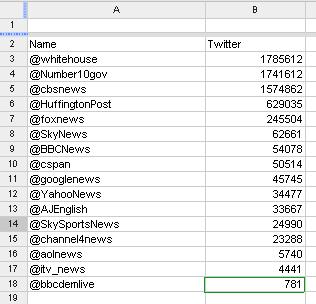
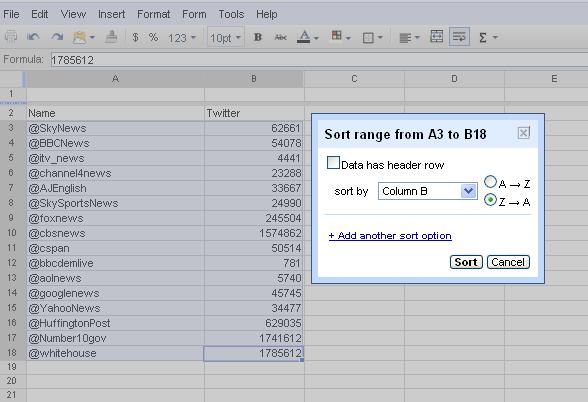
Once you’ve got your set of data you’ll have something that looks like this;

*This spreadsheet shows the number of twitter followers of major news organisations in the UK and US – and the White House and Downing Street to add some intrigue .

This data however doesn’t really tell that much of a story – to find the interest we first have to establish a base on which to work from. This is done by ‘sorting’ the data.

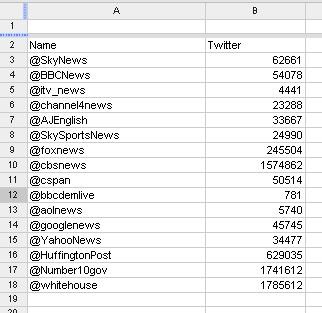
To sort – highlight all desired cells, click tools –> sort –> the column you want sorting (in this case it is B as I’m arranging the data by number of followers) –> select high-to-low/low-to-high –> sort, and you’re away.


This then gives this;

… which is a bit more interesting and you (and your audience) are now able to draw conclusions from the data. What this base also does though is direct you towards further lines of investigation.

For instance, this news services featured in this selection are extremely varied so a direct comparison isn’t really fair. One way then to assert who is currently using twitter to best effect may be to see who’s followers figures are increasing the quickest.

(Reporter tip: In most CAR, the really interesting stories lie in the ‘rate of change’ of the figures)

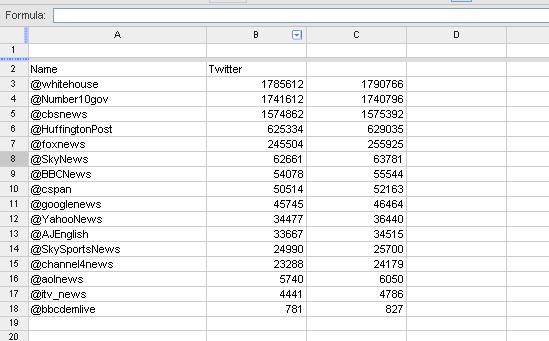
The first set of figures were taken on July 17th, now 12 days later we can see how they have increased.

Using the ‘Formula’ box we can then enter a calculation that will work out the rate of change for each twitter account (as the answer is to go in cell D3, this cell must be selected first). THe equation for this is;

= (new number (C3) – old number (B3) ) / old number (B3)

which gives you;

=(C3-B3)/B3

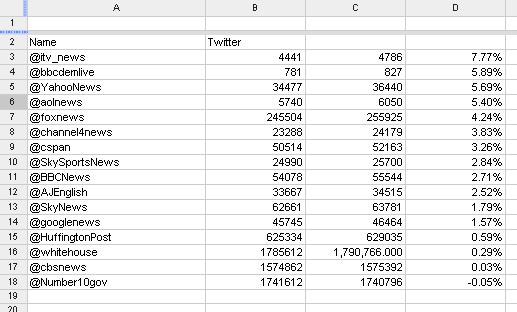
You can then use the the blue square at the bottom of the D3 square to drag that formula into all other cells beneath – giving you 18 ‘rates of change’ in a very short space of time indeed.

By then highlighting the D column and ‘sorting’ again, you can now see who is proportionately attracting new followers the quickest (highlight the column again and click the % box in the tool bar to put figures into percentages)

Other ways to sort data –

– range =C3:C18 (difference between highest and lowest number)
– median = C3:C18 (the middle value – interesting to compare the average)

Relevant tit-bits of information

– the AP style guide recommends giving numbers to 2 decimal places
– if you are starting with imprecise (often rounded numbers) then don’t use decimal places at all as this will only further distort the data
– audiences enjoy being able to see figures and do their own equations – so use the figures as much as possible and don’t clog up the report with unnecessary narrative (as I probably have with this).
– when requesting data, always ask for it un-aggregated and raw

Examining election expenses – What to look for.

These are our top tips for what to look for when going through election expenses receipts:

  1. Any claims that are split between long and short campaigns, or local and general elections, or different candidates
  2. Any claims where only part of the cost is declared, i.e. there are ‘unused’ leaflets etc. that are not included.
  3. Any companies providing services – do they have a connection with the party? (Try to find out who the directors are)
  4. Any costs that are higher than equivalents from other candidates – this might be best shown through a spreadsheet that shows: cost; number of leaflets etc.; cost per leaflet/etc.; company


Initial impressions from Birmingham’s Hall Green & Edgbaston election expenses

Armed with my Apple Mac and a spongy wrist cushion, I set about the task at hand, as I waded through over 100 PDFs of Councillor capital to pinpoint where exactly the funds were going and how effective this use was to us as voters.

After 2 days of tagging and forwarding receipts for anything from sound speakers to sellotape, I had concocted a list of my most interesting finds…

  1. The amount of times I must have tagged the word ‘leaflets‘ into my Hotmail subject window was untrue. It seems that on almost every receipt I looked over there was a charge for leaflets. Small, large, double-sided, full-colour, singing & dancing, they were all there. But this just makes me question ‘are they really getting their money’s worth?’ For example, how many of us actually sit deep in thought about a flyer that comes through our letter box? In all truthfulness it’d be lucky if it got a quick glance before being chucked straight into the paper box. Recycle, recycle.
  2. On a few receipts, I noticed details of ‘equipment hire’… from themselves. I can’t understand how the Liberal Democrats could charge themselves for equipment lease and then reimburse themselves?
  3. I was surprised to find on a number of occasions that some of the candidates had been ‘fined‘ for varying reasons, and this had also been taken out of funds. One example of this was a fine for failing to returned leased goods from a sound company. Apparently only 3 out of 4 megaphones had been returned! Why didn’t they just return them all?
  4. On a few of the expenditure breakdowns, there was a whole host of food receipts for staff. Mostly from ‘Papa John’s‘. 
  5. Now the expense that really wound me up was the ridiculous amount of money spent on ENVELOPES! Just on 6 sets of receipts I totted up a gigantic bill of £3,269.20!! ‘Blue envelopes’, ‘white envelopes’, ‘TNT envelopes’, & even ‘reinforced envelopes’ were purchased in their tens of thousands. On one receipt in particular one candidate forked out on 90,000 ‘windowed envelopes’ costing a whopping £1,054! And the best about it is over 20,000+ weren’t even used! 

To view images of Birmingham’s Hall Green expenses, click here.

To view images of Birmingham’s Edgbaston expenses, click here.

How many databases does Birmingham City Council hold or access?-The Findings.

Birmingham City Council inform us that they have over 1,300 databases – but that they do not know exactly how many, and have no central list on what those are. 

Most of the databases are developed and managed by Service Birmingham, who say it would be too expensive to find out that information. So, what have we found out?…

We managed to locate 37 databases run by varying branches of Service Birmingham. From ‘complaints’ to ‘compliments’, different databases are ran by a range of 8 organisations.

Below I have listed the managing departments and which databases they own:

Chief Executives Directorate:
  • Customer complaints
  • Compliments
  • Elections register
  • Comments
  • Marketing communications lists
  • “etc”

Children Young People & Families:
  • Education files
  • Admission appeals
  • Social care files
  • Disability register

Local Services Directorate:
  • Leisure centre membership
  • CCTV
  • Burial plots
  • Street traders
  • Anti social behaviour
  • Neighbourhood advice

Housing Directorate:
  • Tenancy files
  • Complaints
  • Homeless lists
  • Rent arrears
  • Benefit claims

Birmingham Audit:
  • Data matching
  • Landlords
  • Residency

Revenues & Payments:
  • Council tax
  • Benefit claims
  • Land charges

Adults & Communities Directorate:
  • Care records
  • Blue badge information
  • Protection Lists
  • Police checks

Development Directorate:
  • Planning applications
  • Highways CCTV
  • Parking control
  • Grant
  • Home improvements
  • Travel plan information
The personal information that is entered into these databases are kept under a strict set of guidelines by the Data Protection Act 1998.

These findings show that with a certain degree of perseverance it is possible to get the results you need. As Paul identified in an earlier post, there is hardly any interest in people trying to track down this sort of information. The same goes for electoral receipts and documents that could be harbouring a front page story.

So get asking!

Tips on Freedom of Information requests from James Ball

A couple months ago James Ball came to spend a day teaching Freedom of Information and other skills to the MA Online Journalism students at Birmingham City University. Here are some of his tips:

  • Ring the body before you send any FOI request (their press office, for example) and make it clear that a refusal to provide the information you're asking for will make a really good story too, e.g. 'Culture of secrecy'
  • Avoid asking for personal information – individuals and junior staff are exempt (but not senior staff, i.e. at Level 5 or above of the civil service scale; Director level and other senior staff – e.g. heads of departments – at a local level)
  • Ask for information to be 'anonymised if necessary' to avoid being refused on privacy grounds
  • Ask for street-level detail where possible and relevant
  • Ask for minutes of meetings: steering groups, advisory boards – and ask for the names of the members of those groups
  • If they limit information on the basis of possible 'patchwork' identification argue the case on why it makes little difference
  • If the FOI is refused, ask for it to be taken to internal review and make your case strongly. Internal reviews should be completed within 40 working days. If it fails then, you can take it to the Information Commissioner, but this is likely to take a further 6-12 months at least (some 5-year-old appeals are still waiting for judgements). The story then is likely to be that they have been that they were 'forced to reveal'. Beyond this it goes to the Information Tribunal (you will need a lawyer) and the High Court.
  • Keep up to date with information commissioner rulings at http://www.ico.gov.uk/tools_and_resources/decision_notices.aspx – create a crib sheet of useful rulings to quote and a register of databases mentioned

If you have any other tips, please let us know in the comments.

The logic behind putting election expenses online

I've previously blogged about how to get hold of your local election campaign expenses, and how to easily put them online – but I thought I'd add a third post explaining why I decided to put them online in the form that I did.

I've scanned each expense document (the return forms; each appendix; and each receipt) separately and emailed them to Posterous separately, so that each has its own blog post. This means that each expense document has a unique URL, so people can link directly to it when talking about it.

If all documents were put into a single PDF or all PDFs put into a single blog post it would make it more difficult for people to identify which document was being talked about.

Separating the documents this way also means that people can comment on individual documents, so it's easier to keep track of which documents have been looked at and which not.

Comments also make it easy to find individual posts, as the comment text itself will appear in search engines.

And finally, it means that each blog post – i.e. document – can be tagged separately.

Tagging is possibly the most important part of the whole process, for a number of reasons:

  1. It makes it much easier to find the documents on a search engine. Sites such as Google use tags to understand the content of a page – this is particularly important when dealing with PDFs, as Google cannot 'read' them in the same way it can read plain text.
  2. It also makes it much easier for users to find particular types of documents when browsing the blog itself. The right hand column of the blog has a list of tags that you can click on so that, for example, you are only looking at the expenses of the Labour Party, or documents relating to the short campaign.
  3. This also makes it possible for people to link to specific types of documents, in addition to individual ones, or the blog as a whole.
  4. Finally, tags make it possible to do interesting things with computer scripts. Someone could, for example, write a script to find every document tagged with a particular company name across a number of areas, or to combine results with two tags, or either of two tags.

If you have any other ideas for better ways of putting the material online, let me know.

Getting election expenses from your local elections office

How do you get the expense receipts for election candidates? It’s really very simple – so why isn’t everyone doing it?

You first need to contact the Elections Office for your local council – in Birmingham their email is elections [at] birmingham.gov.uk (you should be able to get their contact details by ringing your council’s general contact number)

  • Tell them that you will be arriving later that day and which expense returns you will be looking at. You can look at them all for free in their office, but if you want to take away a copy you’ll have to pay 20p per sheet, so it’s probably best to look at them first before choosing which pages you want copies of.
  • Ask for directions to the office as it may be tucked away – this video shows where Birmingham’s Election Office is located, on up a side alley off Great Charles Street.
  • Expenses are divided into the ‘short campaign’ (the period of around four weeks after an election is announced) and a ‘long campaign’ (the period before the election is announced). I found at least one candidate put all the receipts for both into one bundle, so it’s worth getting both out.
  • Check for missing sheets.

That’s it. There generally isn’t that much to look at in the short campaign receipts so you shouldn’t be there too long.

Curiously, the Birmingham office told me that no one ever comes to look at the receipts (apart from one election candidate), so someone should.

It’s a good idea to bring a laptop if you have one and copy key details across to a spreadsheet (company names, etc.).?

I published?the campaign expenses of candidates in Edgbaston on a website: Edgbaston Election Campaign Expenses 2010?- and I blogged about how I did that.?

Background: A Channel 4 investigation has “raised questions over the election expenses of Zac Goldsmith” – in particular only claiming partial expenses on the grounds that ‘not all material was used’.

The responses of Goldsmith and the Conservative Party suggest “candidates were justified in only accounting for items used as material can become out of date during a campaign … the examples raised could be seen in the returns of other candidates.”

We want to see if this is true. Are other candidates not claiming for the expense of ‘unused’ materials? Or is Goldsmith an exception?

We’ve started one investigation in Birmingham but would really welcome sister investigations in other towns and cities.

Getting election campaign expenses online

I’ve just put all the election expenses for the main 2 candidates in the fiercely fought Edgbaston constituency online so that people can look at them, post comments and link to them if they need to make a point.

Here’s how I did it:

  • I went to the Elections Office in Birmingham to get a copy of the expenses returns. I’ll blog about this separately. Strangely, I was told that, while they could photocopy the documents, they couldn’t photocopy to PDF because they were “too big”. This exercise is at least in part about demonstrating how easily the returns could be put online.
  • I then photocopied each sheet of the returns to PDF, and sent it to my email. Most relatively modern photocopiers can do this.
  • I set up a new blog using Posterous.com called Edgbaston Election Campaign Expenses (for search engine optimisation) and added that email address to the contributors (in the Manage menu)
  • I forwarded each email to the address associated with that blog (post@edgbastonelectionexpenses.posterous.com).
  • I tagged each emailed document by using a standard header for each email that I copied and pasted – at the end of the header were a series of tags in double brackets like this: ((labour, gisela stuart, expenses, edgbaston)). This makes it easy to find particular types of documents.

That’s it.

I’ve still got a bunch of receipts to put on the blog for Gisela Stuart which I’ll try to do tomorrow. And then it’s Hall Green.

The point of the blog is to help provide some context to the Zac Goldsmith election expenses investigation. We’ll also be digging into these receipts for some investigations of our own.

But it’s also to show how it can be done – if you want to get your own candidates’ expenses online, let me know in the comments and I’ll be happy to help out.