Data: Free Schools and disadvantaged children

SchoolDuggery has published some data on free school meals:

“We estimate that fewer than 400 children entitled to free school meals (FSM) are attending the first wave of free schools, according to data supplied under a Freedom of Information Act request by 23* of the 24 schools. The data shows that in these 23 schools just 9.4% of the 3811 children on roll were registered for free school meals in October 2011. Nationally, 16.7% of children are entitled to claim free school meals because their household income is below £16,000. ”

“*One school did not respond the FOI request within the statutory timescale: Kings Science Academy. We will update the data when they provide it.”

The tables are embedded on the blog post but can be easily pulled into a spreadsheet using the =importHTML formula. Here’s one we prepared earlier…

Lots of analysis over at the excellent SchoolDuggery, and some interesting and valuable comments too.

Posted in Data, Links | Tagged , , | Leave a comment

Help Me Investigate Education is now on Twitter

We’re now on Twitter! Make sure you follow @HMIeducation for the latest posts, investigations, and news regarding education in the UK.

Posted in Uncategorized | Leave a comment

Data: Free schools taking fewer deprived students

Yesterday, the Guardian reported that free schools are taking lower numbers of deprived students. The BBC defines free schools as schools “set up by groups of parents, teachers, charities, businesses, universities, trusts, religious or voluntary groups, but funded directly by central government.”

The article was based on data obtained from a FOI request sent by primary school governor Rachel Gooch, who had blogged about the results she found. The Guardian sums up her findings:

Gooch compared the intake of disadvantaged children at each of the free schools with the five nearest schools for pupils of a similar age group. She found that all but one of the free schools were taking fewer deprived pupils than average for their neighbouring schools.

The findings are at odds with the coalition’s claim that free schools are empowering working-class families. Michael Gove, the education secretary, has said the creation of free schools is intended to tackle flaws in the education system, including a concentration of the weakest schools in “our poorest towns and cities”.

One thing I want to note: In the comments section of Gooch’s blog post, Toby Young, who founded the West London Free School, flat out called Gooch a liar for her results. She responded by posting the letter from the personal assistant to the school’s headmaster that stated the data she used. He later apologized. That’s a great example of how to stand up for the data you find.

What else do we not know about free schools? Are they actually helping disadvantaged children? Are they worth the expensive price tag?

Posted in Data | Leave a comment

New education data promised on pupils’ progress

Writing in today’s Telegraph David Cameron announced plans to release new education data detailing rates of pupils’ academic progression.

In an effort to tackle what he labels “coasting schools” – comprehensives in middle class areas which are failing to push high-ability pupils –  Cameron pledged:     

“From January, we are going to sort out league tables so that everyone involved in schools can see for the first time whether they are doing as well as they should

From June, we will release data about the performance of all pupils from the National Pupil Database. Of course, it will be anonymous, but you will be able to see what happened to individual pupils: where they started, the progress they made and where they ended up.”

Continue reading

Posted in Data | Tagged , , , , | 1 Comment

How-to: find out academy charity salaries

Here’s a lesson in how to investigate salaries surrounding academy schools: a Guardian report that “Charities that run chains of academy schools are using public funds to pay senior staff six-figure salaries, with some on £240,000 or more.”

It arrived at that figure by looking at the most recent annual reports of 5 major chains.

There is a distinction to be made between paying academy school staff and paying staff in the charities that run those schools, but the use of annual accounts – which charities must file with the Charity Commission – is a good way to look into the overall picture, particularly when you can compare across time and with wages in state schools:

“One member of staff at the Academies Enterprise Trust earned between £200,000 and £209,999. No member of staff had been in this pay bracket the previous year, the accounts show. The chain grew from three to six academies between August 2009 and the following year.

“The chains would not, with the exception of Liddington, reveal which senior staff had received the most generous packages. However, senior staff include finance and education directors of the chains, as well as academy headteachers. The packages tend to include salary, bonuses and, in some cases, pension contributions.

“Academies receive a similar amount from the Department for Education as state schools that work with local authorities do. However, academies are given extra for the services that councils would have otherwise provided and they do not have to adhere to strict rules governing the pay and conditions of senior staff, as state schools working with local authorities do.

“The maximum annual salary of a headteacher at a state school under local authority control is between £79,835 and £112,181. Only a headteacher in a large inner London secondary school would be eligible for the higher sum.

“The accounts also show that another member of staff at the United Learning Trust earned between £150,000 and £160,000, while three at Ark Schools were paid between £140,000 and £150,000. No staff at either chain were in these pay brackets the year before. Four employees of Harris Federation earned between £130,000 and £140,000, compared with just one the year before.”

If this makes you want to start investigating something similar, let us know how we can help.

UPDATE: From Jane in the comments:

Unfortunately, the Academies Act 2010 changed the charitable status of academy trusts. They are now exempt charities and all the major ones were very, very quick to deregister from the Charities Commission. opencharities.org was a route for getting previously filed accounts up to 2009 but, in checking, I have just been having trouble getting on to the site. I did do an FoI request to the Charity Commission and you can, that way, get previously filed accounts but still not current ones, which are available from Companies House for a fee.
Posted in Links, Tips and How-Tos | Tagged , , , , , , | 5 Comments

Investigating the special education system 1: inclusion statistics

More and more attention has been paid to children who have special educational needs (SEN) after Ofsted’s report last year criticised teachers for overusing the term. But fewer investigations have focused on the experiences of children who have the most severe learning difficulties, those who have been granted statements of special education needs. We want to investigate the educational opportunities available to such students.

The Department for Education publishes datasets detailing the numbers of statemented SEN pupils across local authorities and the types of schools which they attend.

I plan to analyse this information in detail by looking at the size and specific types of specialist schools available in different areas – and the impact which this may have on local authorities’ attitudes to inclusion. As well as posting updates to this site I’ll be blogging in more detail about SEN statistics here.

Do you have experience of the special education system? Please help me investigate. I’m especially keen to talk to people from different regions. Let me know your thoughts by commenting or emailing me directly at ratcliffe.rc[at]gmail.com.

Posted in Uncategorized | 1 Comment

The price of a University drop-out 2: how do you work out the numbers?

In part 1, we tried to sift through the rulings and regulations and explain exactly how the HEFCE fund higher education institutions, and what criteria must be met.

Next, before finally digging into the data in detail and filtering out some numbers, it is key to identify how the data is constructed (before we deconstruct it).

If you look at it from the outside, predicting how many people will ‘non-complete’ near the beginning of the school year is a difficult task, but these predictions must be made in order to suggest and make payments for every year.

Universities send off a HESES (Higher Education Students Early Statistics Survey) in December, which quotes the number of student registrations for the year along with an estimation of non-completions, which has to be derived from the previous years non-completion figures. This is then negotiated and agreed upon.

Still with me? Ok.

HESA (Higher Education Statisics Agency) are then sent year-end figures which include the actual non-completion rates, which is then analysed for integrity and signed off in mid-October. This is then used to derive the figures for the following year after any gaps in the numbers are considered.

This prodecure, although extensive and rigorously checked can leave some gaps in the numbers, which is one of the first things we want to investigate when looking at the figures, which we have received from BCU and Birmingham University.

Another priority in picking apart the data is finding out to what extent different universities suffer from mid-year drop-outs, and what the difference would be if 100% of students stayed committed to their course.

Finally, what we can derive from that is whether universities that take on more students that are likely to non-complete (non red-brick, not trying to be biased here but the data should help prove or disprove that manner of assumption) are penalised more heavily than universities that tend to have a higher completion rate.

And, that’s for another blog post.

Posted in Data, Follow The Money | Tagged , , , , , , , , | 2 Comments

Links: How Seattle journalist got school censorship scoop

Al Tompkins, from the Poynter Institute, an online organization focused on journalism based in the States, has posted a great Q&A with American journalist Phyllis Fletcher. She is an education reporter for a radio station in Seattle, Wa., and recently revealed a policy change in the school district she covers that would censor the schools’ student newspapers.

The story had immediate results, reports Tompkins.

At first, school officials denied there had been a change. Then they agreed there had been. Within a few days of Fletcher’s report, and a flood of media follow-ups, the school district completely reversed the policy.

What I like best about this interview is that it’s a great tutorial on what skills you need to complete an investigation. Fletcher says:

You also have to find and expose things that haven’t risen even to the watchdogs’ finely-tuned radar. That means you have to find things that haven’t made anyone angry (yet). You’ll find things that are quirky, interesting, odd, or that demonstrate that the right hand doesn’t know what the left hand is doing.  The more you bring these things to light, the more you and your audience learn, and the more you build credibility with tipsters — and with the body you cover.

This is a must-read for those of us covering the education beat.

Posted in Links | Tagged , , , , | Leave a comment

FOI legislation opens up UCAS and higher education…

As of this month, there are three more organisations that are under the scope of The Freedom of Information Act; and most appropriately for the Help Me Investigate education site, UCAS, the charitable organisation who organise the higher education application process, are now susceptible.

So, you can now look into the £21m of charitable spending from last year, the ways in which they facilitate the advancement of higher education by running charitable teaching programs and events for young people, or the running of the higher education admissions service itself.

However, the fact UCAS are a charity means that there are some conditions and exceptions and as a result, there is a limit on the information the public can access.

Basically, it’s key to differentiate between the commercial actions and the public actions; you can only gain access to information that makes them accountable to the public.

Their Guide to Information outlines what information can be accessed and points out the stores of information already available to the public.

They’ll also make it easy to access public information that is clouded or blocked by their commercial interests, as well as storing previous responses to previous Freedom of Information requests.

Under the new legislation, the College of Agriculture Food and Rural Enterprise is also subject to the Act.

Posted in Links | Tagged , , , , , | Leave a comment

Young learners’ data released

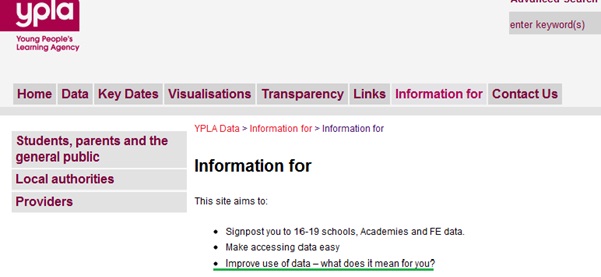
As part of the Government’s data opening process, the Young People’s Learning Agency (YPLA) has launched its data website. With an “emphasis on transparency,” the site sets to publish all their public data on Academies, 16-19 year-olds and Further Education under one umbrella.

The website includes a Google publication calendar, reminders and yet-to-be-accessible visualisations, alongside its data sets. The data itself is separated into information on residents and information on institutions. So far the published data sets reveal analysis and reports filled under the following themes: the learning landscape; attainment and progression; progression and residency.

The YPLA Data site aims to reach the interest of students, parents, the general public, local authorities and providers (or learning establishments).

Young People's Learning Agency Data website aims

For local authorities, the website recommends usage alongside another YPLA tool, the Information Management portal (IM) which is private. It also adds that data will be “first published on the IM Portal for a given period prior to publication” which begs the question of the reasons behind releasing this website for local authorities, since, presumably, they already have access to it privately via the IM Portal.

As of April 2012 the website will go under the Department for Education (DfE). Since April is the first month of the financial year, the question of funding arises: Will the DfE be financing this website starting next year and who is paying for it at the minute?

Posted in Data | Tagged , | Leave a comment

Links: unreliable data on children’s services (FactCheck)

Channel 4’s FactCheck reports on some very shaky data being submitted by local authorities to the Department for Education. After listing a number of figures which varied wildly from year to year, and a response from a DfE spokesman that the numbers were “not very accurate”, reporter Patrick Worrall sums the picture up:

“So to recap, these spending figures don’t actually reflect the real amount of money spent; figures from different councils are not comparable with each other; spending in one year can’t be compared usefully with other years; and the government doesn’t propose to audit the figures or correct them when they’re wrong.”

The data is important, Worrall points out, because it will be used as part of the way that money is reallocated to the new academies.

“Many councils’ complaints, made plain in responses to an ongoing government consultation, hinge on DfE’s use of S251, a document it has variously described as “unaudited”, “flawed” and”not fit for purpose”.”

Sadly, the post fails to link to either the flawed data, the consultations, or any of the other evidence it mentions – which would allow others to dig further.

Can you can help find those links?

Posted in Data, Links | Tagged , , , , | 1 Comment

How To: Find out when the Department for Education will publish its next stats report

No matter what topic you’re investigating, data will almost always play a key role. The right statistical information can answer questions you didn’t even realize you had. So it helps to have a good grasp of the data.

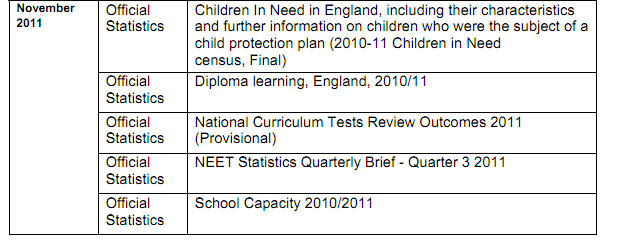
A big part of this is keeping tabs on when important reports are coming out. The Department for Education, a great resource for official stats on education in the UK, routinely posts a calendar of when it plans to publish statistical reports in the next six months.

The schedule for Oct. 2011 to March 2012 can be accessed here. Below is a screenshot of statistical reports planned for this month.

Just a note: This list only states in which months publications are expected to be published. For more specific release dates, check either DfE’s Research and Statistics Gateway or the UK Statistics Authority Publication Hub. (Both are also good resources to access full copies of the reports.) Release dates are announced at least four weeks before the data is made public.

What are other good resources for finding out when important reports will be released?

Posted in Tips and How-Tos | Tagged , , , | Leave a comment