Number of employees on zero hour contracts doubles in 6 years

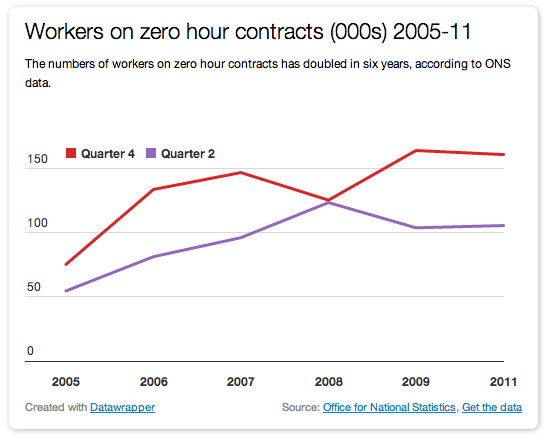
Zero hour contracts 2005-2011
Zero hour contracts 2005-2011 – click to see a larger, interactive version

Official data shows a dramatic increase in the number of people on zero hour contracts since 2005, writes Danielle Hudspith.

In the six years since then the number of people working on zero hour contracts between April and June rose from almost 55,000 to over 105,000.

And between October and December the figures more than doubled from over 75,000 to almost 161,000. Continue reading Number of employees on zero hour contracts doubles in 6 years

Factcheck: 900,000 dropped benefit claims “rather than complete assessment”?

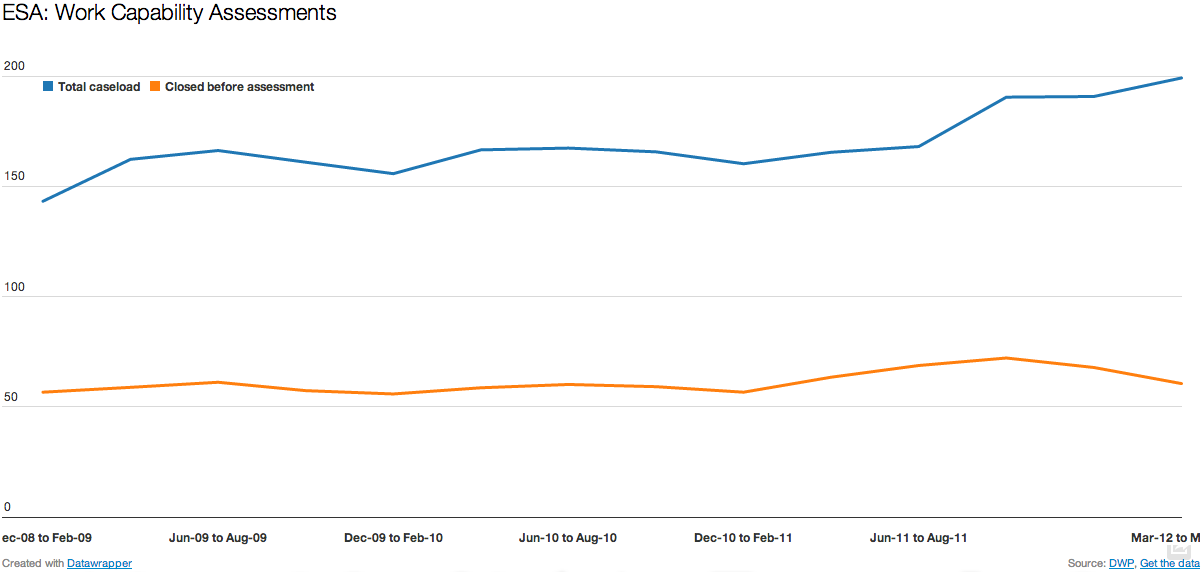
ESA: Work Capability Assessments
ESA: Work Capability Assessments – total vs dropped

On Saturday a number of media outlets reported Government claims that nearly 900,000 people dropped benefit claims “rather than undergo a tough new medical test“. Reports in The Telegraph, Express, Daily Mail, MSN and Wales Online, based on a Press Association story, however, fail to dig deeper into the claims.

How accurate are they? Steve Walker has looked at the data, following a pointer from Declan Gaffney, and found the pattern of ‘dropped claims’ doesn’t support the headlines. HMI Welfare has re-checked and re-presented it, along with some documentary context. Here are the key findings: Continue reading Factcheck: 900,000 dropped benefit claims “rather than complete assessment”?

The Bedroom Tax investigated in Birmingham: no place to go

Sharing a room with her four year old disabled son, Brenda*, a single mother from Ladywood, is just one of the 37,000 households in Birmingham living in congested conditions, making the West Midlands responsible for almost half of families living in overcrowded accommodation across the country.

With an increasing demand for properties and an acute shortage of social housing, the idea of taxing council tenants who maintain a spare room seems reasonable, but a closer investigation into the matter by a team of Birmingham journalists reveals that this taxation may not only be affecting society’s most vulnerable but also adding to a worsening housing situation. Continue reading The Bedroom Tax investigated in Birmingham: no place to go

Guide to deferring a mortgage-style student loan repayment

Types of student loans

If you took out a student loan while taking a university or college course that began before September 1998, you will have been given a loan known as a ‘mortgage style’ or ‘fixed-term’ loan. (Loans taken out after this point are known as ‘income-contingent loans’.)

Mortgage-style loans are paid directly to the Student Loans Company (SLC), the public-sector body that provides student loans, unlike income-contingent loans – for which HMRC collects repayments.

Interest rates on mortgage-style loans are typically higher than those for income-contingent loans because they are linked to retail price index (RPI) inflation. Interest on mortgate-style loans stood at 3.6% in January 2013, whereas interest on income-contingent loans in the same month was 1.5%.

Deferring repayments

You’ll usually have to repay mortgage-style loans through monthly instalments by direct debit. However, you may be able to defer repayments for one year at a time if you earn £27,813 or less per year, before tax or National Insurance are deducted from your pay. Repayments on income-contingent loans are deducted automatically from your wages and can’t be deferred.

If you’re eligible, you can defer payments by completing a form issued by the SLC and returning it by post. The SLC sends deferment forms directly to customers by post. If you have deferred another repayment at an earlier date, the SLC states that it will send you a form about two months before your next payment falls due.

What do you need to complete the deferment form?

The SLC requires you to complete, sign and date the form and post it directly to them with evidence of your ‘current means of subsistence.’ If you are claiming benefits, the SLC says that it will accept any one of the following pieces of evidence:

  • A Benefits Agency/Jobcentre stamp on the deferment application form.
  • A copy of a current benefit agency book confirming the customer’s name, address, date and the amount of benefit received.
  • A Benefits Agency letter confirming the customer’s name, date, type and amount received.
  • A recent bank statement showing benefits payments being made to the customer’s account.

The evidence needed if you are employed, self-employed, travelling, a student or living on unearned income is listed here.  According to the SLC, you’ll automatically be sent a new deferment form if your application has an obvious mistake – alternatively, you can contact the SLC to request a new form on 0141 243 3902.

At the time of publishing the DWP had declined to comment.
Illegal use of B&Bs to house homeless families – how to investigate your local figures (and learn some useful data techniques too)

The Guardian’s Randeep Ramesh reports today on the use of bed and breakfasts to house families beyond the legal time limit of six weeks.

The national picture is that half of the 242 authorities who responded had placed homeless families in private accommodation for more than 6 weeks since April 2010. But what’s your local picture?

A good first stop is your local authority’s expenditure above £500. To find this, try a search like ‘expenditure 500 site:bolton.gov.uk‘ – but replace the last bit with your own local authority’s website (excluding the www.).

Download it and open in Excel or Google Docs (if you need to convert it from PDF try pdftoexcelonline.com). Now it’s time to filter… Continue reading Illegal use of B&Bs to house homeless families – how to investigate your local figures (and learn some useful data techniques too)

Welfare-related links for December 21st through January 25th

These are the welfare-related links we’ve been looking at between December 21st and January 25th:

  • Management in Practice – GPs could help save £190m in sick pay – Launching in 2014, the advisory service will allow GPs to identify employees who need support as well as issuing 'fit notes'. Lord Freud, Minister for Welfare Reform said: "Long-term sickness absence is a burden to business, to the taxpayer and to the thousands of people who get trapped on benefits when they could actually work.
  • The cost of government: what does the new transactions data really tell us? | News | guardian.co.uk – And the worst offender? The massive Department for Work and Pensions, which is Britain's biggest spending government department and administers benefits. So, for instance we have no idea how much it costs to process each of the 40m Jobseeker's allowance signing ons or to administer the benefit's 3.4m claims. The Department is responsible for 48,704,000 transactions in the high volume list alone – and we don't know the cost of any of them.
  • Reasons to be fearful: Oakley & Policy Exchange, foxes in the benefits coop | skwalker1964 – To keep this post to a readable length, I won’t go into detail on some of the other proposals that Mr Oakley would like to see implemented, or wild opinions that he holds, but will just list some of them:

    All assistance for unemployed people to find work provided by private/charitable providers
    Time-limiting unemployment benefits
    Cutting regional pay to fund infrastructure spending – thereby penalising those who are already disadvantaged in order to fund growth-measures, rather than taxing the wealthiest
    Selling public housing in expensive areas to private owners, forcing social tenants out of ‘desirable’ areas
    Claiming benefits leads to criminality
    Re-distributing income to low-paid people is a bad idea, because it ‘does nothing to encourage progression and self-sufficiency‘.

  • Request Initiative » Eleven work and pensions civil servants sacked for using Twitter or Facebook – The 11 sacked officials are among 116 DWP employees to have faced disciplinary action for blogging and social networking since January 2009, according to figures revealed under the Freedom of Information Act.
  • What is George Osborne doing to benefits? | Society | guardian.co.uk – Let's imagine someone receives £100 a month, all of which is spent on goods and services (domestic heating, food, bills, etc). The current inflation rate is 2.7%, which means in a year's time buying the exact same things would cost £102.70. Under the previous system, this is what benefits would've risen to. But with the changes, they would now only rise to £101 – leaving the recipient £1.70 worse off. Given the changes will last for at least three years, this represents a cut in income of between 3% to 6%, depending what happens with inflation. In reality, the impact could be even worse, as research by the Institute for Fiscal Studies suggests low-income households experience a higher inflation rate than richer ones.

Helping connect those investigating the welfare system