Data: Welfare spending breakdown

The Labour blog Left Foot Forward provides a useful breakdown of UK welfare spend that demonstrates where most of the money is going, and how that might be shaping government policy.

Despite the spin on unemployment and immigration, for example:

“Almost half our welfare expenditure, all £78.4 billion of it, is spent on our ageing population. And the number of people drawing a state pension is ever-growing”

Benefit and tax credit expenditure, 2009-2010

Next, “A breakdown of [the 22.08 per cent of welfare expenditure that goes to workers on low incomes] shows an enormous focus on housing, which explains the increased attention on housing benefit:”

Welfare expenditure for people on low incomes, 2009-2010

Simple, but useful. Sadly, there’s no link to the raw data. Interestingly, in looking for that I found this website on UK public spending – created by left wing blogger Christopher Cantrill. As both of these sources have a self-declared political orientation, it’s worth tracking the source of the data, declared here.

(By the way, regarding political bias: if a source has declared it, that doesn’t mean their information is not valid, only that you need to check the information. If a source has not declared a bias, you should always assume they have one, and still check the information.)

Can you add anything more?

Disabled group releases report to oppose benefit reforms

A report published today on the controversial welfare reform bill, reveals Parliament may only have been told the partial truth about the overwhelming opposition to the government’s consultation on the planned changes to the Disability Living Allowance (DLA).

Some of the main conclusions of the document, which came to to be known as the “Spartacus report”, are summed up below:

  • Only 7% of organisations that took part in the consultation were fully in support of plans to replace DLA with PIP
  • There was overwhelming opposition in the consultation responses to nearly all of the government’s proposals for DLA reform
  • The government has consistently used inaccurate figures to exaggerate the rise in DLA claimants
  • The report shows that nearly all of the recent increase in working-age claimants of DLA has been associated with mental health conditions and learning difficulties. Between 2002 and 2010, the number of working-age DLA claimants – excluding those with mental health conditions and learning difficulties remained remarkably stable
  • 98% of those who responded opposed plans to change the qualifying period for PIP from three months (as it is with DLA) to six months
  • 90% opposed plans for a new assessment, which disabled people fear will be far too similar to the much-criticised work capability assessment used to test eligibility for employment and support allowance (ESA)
  • Respondents to the consultation repeatedly warned that the government’s plans could breach the Equality Act, the Human Rights Act and the UN Convention on the Rights of Persons with Disabilities

The report, based on data obtained through Freedom of Information requests, was written by Sue Marsh, author of the Diary of the Benefit Scrounger blog. It was researched and funded by thousands of sick and disabled people, who are about to be affected by the cuts to their benefits.

A contributor from the campaign group told Help Me Investigate:

“We have an army of over 600 volunteers to act as ‘constituency reps’. Each has the responsibility to contact their MP in their area with the report, so this will go very widely indeed. We are expecting a lot of press coverage.”

With only two days to go until the House of Lords votes on the bill, the group plans to campaign on Twitter as well and hope to get their hashtag #spartacusreport trending this morning.

Writing on the Guardian’s Comment is Free, Sue Marsh said:

“As evidence of the need for reform, the government has always claimed that DLA figures have risen by 30% in eight years. However, our analysis shows that this too is misleading – in fact the government has admitted that it gives a “distorted view”, yet continues to use the figure when pushing for reform.”


Data: limited housing availability following benefit caps

The Guardian is following the caps to housing benefits with data on the limited housing now available across the country to “job seekers [, the] disabled, lone parents, others unable to work such as pensioners or those in low paid employment.”:

“The study shows in many parts of the country there will be thousands more welfare claimants than there are properties that can be afforded by benefits alone – raising the possibility that the poor will be compelled to migrate to “benefit ghettoes” along the coast or in the north. Try for yourself by clicking on the accompanying map – for example Brighton and Hove shows”

Help Me Investigate Health contributor Carl Plant has already visualised some of the data here.

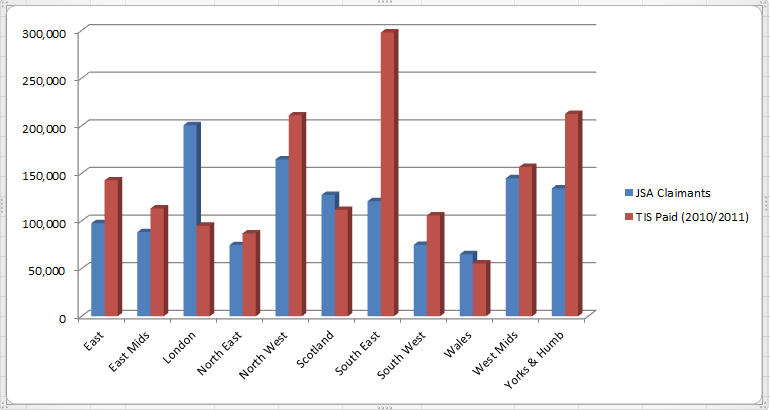
JSA claimants vs.Travel for Interview – the chart

In our previous post, Oliver Conner analysed the number of jobseekers claiming JSA against the amount of Travel for Interview Scheme (TIS) money awarded in 2010/2011.

The JSA claimants’ figures are from 2010 (source: ONS) and the TIS data (source: DWP in a response to an FOI request) covers April 2010 to around August 2011. Of course we are comparing two different types of numbers: amounts of money and total numbers of jobseekers. But if you take the relative national value of those figures, it gives us a good idea of the regional differences.

I have created a chart using Oliver’s figures to facilitate visualisation. Continue reading JSA claimants vs.Travel for Interview – the chart

Helping connect those investigating the welfare system