Where do you find data to put your story into context – or give you ideas for stories in the first place? Here are some of the places that come in handy for understanding health in England and the UK as a whole:
1. Indicator Portal (HSCIC)
The Health and Social Care Information Centre‘s (HSCIC) Indicator Portal is a treasure trove providing detail down to GP surgery or hospital level on everything from mortality and disease prevalence to patient experience.
But it also includes socioeconomic data, like the proportion of people in an area who have been out of work for over a year, the number of robberies in an area, and homelessness, plus education and environmental factors.
There’s quite a time-lag on most of the data, sadly – sometimes it’s from 2011 – so it’s best for background rather than new information.
2. Situation reports (SitReps)
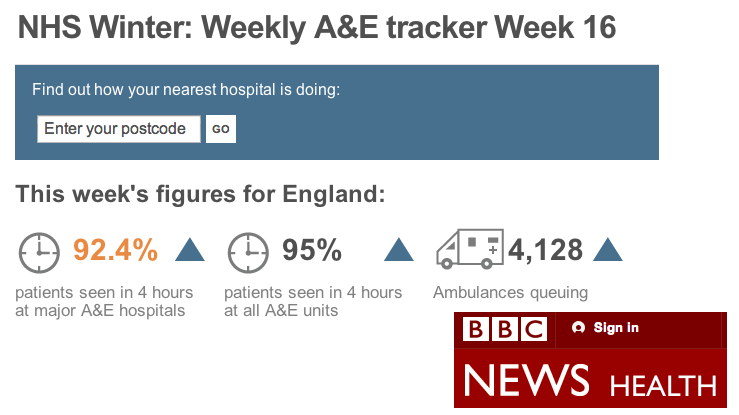
If you want really up to date information it doesn’t get much better than the SitReps published by NHS England, which provide information on A&E admissions and waiting times for the last week.
The BBC recently used the data as the basis for a live A&E tracker. As you can see, the key approach is to put the figures into context, both nationally and historically:
3. Hospital Episode Statistics (HSCIC)
The HES section of the HSCIC site contains all sorts of information about how patients are admitted to hospitals and what happens to them, including maternity services.
The navigation on the site is not particularly easy to follow – for example many of the most useful links are on the right hand side of the page.
Also, a lot of the data is only at aggregate level – try adding the phrase “Provider level analysis” or “by provider” in the search box to get more detail by hospital or trust. It’s not timely but it is more timely than the Indicator Portal – in March 2014 you can get data up to December 2013.
Helpfully, the site does provide a publications calendar, so you can plan ahead for future releases.
4. Gov.uk and Data.gov.uk publications
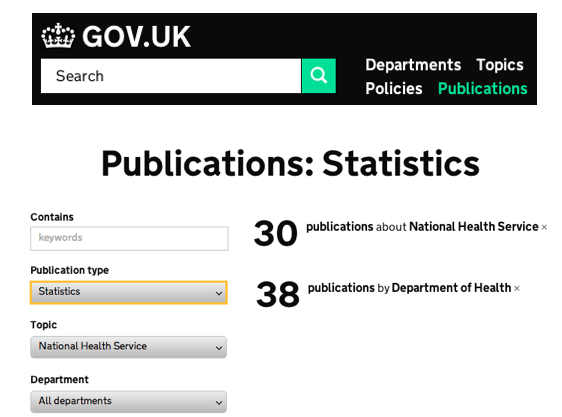
Not all data about health is published by NHS England or the HSCIC. The central Gov.uk website’s Publications section allows you to subscribe to email updates or RSS alerts when new information is published that covers the topic ‘National Health Service’, or comes from the Department of Health – or you can simply choose those containing a keyword such as ‘health’.
You can also choose to get updates on all publications, including research and consultations, or just statistics.
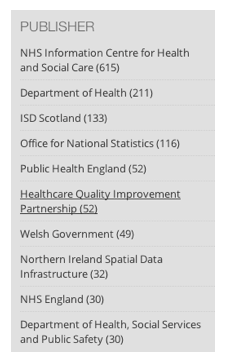
A similar central repository is the Data.gov.uk website, which allows you to search by keyword, select the ‘Health’ theme, or browse by publisher (department or body). There’s a lot of overlap here, but you may find data on one which isn’t on the other.
5. TheyWorkForYou and WhatDoTheyKnow
There’s plenty of data released in responses to FOI requests. Getting hold of those isn’t easy, however, as there are hundreds of bodies which potentially could publish responses.
Some are published on the Gov.uk publications site listed above, but it’s also worth subscribing to an email or RSS alert from the FOI request site WhatDoTheyKnow. You might try a broad search like ‘health’, or a type of organisation, like ‘CCG’.
Another useful source is Parliamentary written answers: these are responses to questions from MPs and Peers and often include tables of data. You can use the sister site TheyWorkForYou to search written answers specifically (use the drop-down menu for Section) and/or specify that you’re only interested in answers from the Department of Health. Here’s an example search for ‘health’.
6. Regulators and auditors
The Care Quality Commission (CQC) inspects a range of health services, from hospitals and GP surgeries to dentists and care homes.
It publishes some (not very useful) data that basically lists details on the “places that provide care”, including the date last inspected. But its most useful data – results from almost 100,000 inspections, comes from browsing its directory and clicking on individual links.
Also worth looking at is the National Audit Office, which has a section of reports on health and social care.
Scotland, Northern Ireland and Wales
Many of the links above relate to data for England, but the same data is normally available at similar sites in Scotland, Wales and Northern Ireland – these include:
- NHS National Services Scotland has its own Information Services Division, there’s a Scottish Public Health Observatory, and Scotland’s government has a page on health statistics. Audit Scotland publishes audits on council performance including issues related to health, such as social care.
- Wales has a number of data sources including the statistics section of the Welsh Government website; NHS Wales‘s data page; and StatsWales‘s data on health and social care. The Wales Audit Office is another useful source of health reports.
- In Northern Ireland the Department of Health, Social Services and Public Safety is the first port of call, with data on public health just one of a number of areas available in its statistics and research section. There’s also Health and Social Care in Northern Ireland‘s Public Health Agency, which publishes surveillance data on infectious diseases, vaccination and specific infections, and the Northern Ireland Audit Office.