Stoke and Huddersfield papers report on torch relay costs

Stoke Olympic torch relay costs

The Stoke Sentinel and Huddersfield Examiner have reported on Freedom of Information requests from Help Me Investigate about torch relay spending.

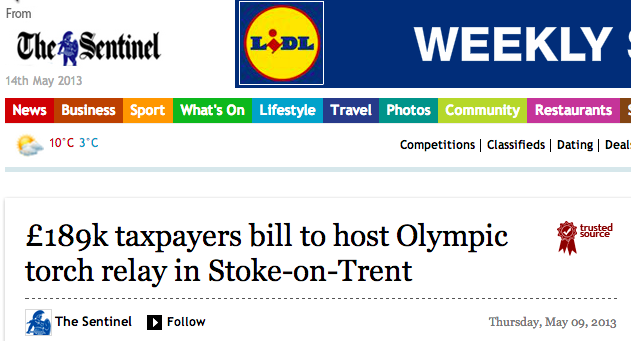
This is Staffordshire report on the £189,730 cost of the relay to Stoke-on-Trent City Council, while The Huddersfield Daily Examiner’s Linda Whitwam asks “Was [the £56,000 cost] worth it?” Continue reading

Torch relay bill update – 128 authorities, £5.5m

128 public authorities spent a combined £5.5m on staging the Olympic torch relay, according to the latest figures being compiled by Help Me Investigate users.

The figure – based on Freedom of Information requests to local councils and police bodies – adds a further £1m to the costs identified based on a survey of 100 authorities in February, and further supports the estimate of a national cost at over £13m. Continue reading

Sutton Guardian picks up Olympic torch relay figures

The Sutton Guardian have reported on local spending on the Olympic torch relay disclosed as part of Help Me Investigate’s investigation.

Mike Pyle writes that the local council paid £9,000 for the torch’s journey through the area. This covered stewards, barriers, road closures, road signs, St John Ambulance staff, street cleaning and publicity.

Those costs combined came to less than a fifth of the cost of bunting in the area, one of the highest in the country: £50,000 was used from another local government body to fund the decorations.


Leicestershire’s £230,000 Olympic torch relay bill – Leicester Mercury

The Leicester Mercury’s Dan Martin reports on torch relay spending in the county:

“The council said it footed a bill of £102,641 when the torch came to the city last July. Most of that, £81,560, was spent on a giant party in Abbey Park, attended by about 20,000 people to celebrate the torch’s arrival.

“The rest was spent on closing the roads, crowd barriers, security, and first aid provision as the torch entourage passed through the city.

“Leicestershire County Council told the Mercury it spent £29,600 on traffic management and staffing as the torch passed through the county in July and during a rehearsal for the relay in April.

“Leicestershire Police said it cost them £103,629 in staffing and overtime to supervise the rehearsal event and the real thing.”

The figures tally with data we’ve published on councils’ spending on the relay. Leicester City Council were one of the biggest spenders in the country.

The figures given to the Mercury, however, omit to mention that the total costs before external funding and income were much higher, at around £150,000. Curiously, the city did not seem to have received any funding from LOCOG for hosting a dress rehearsal for the Olympic organisers.

The Olympic letters that cost as much as road closures – Birmingham

The Birmingham Mail have published one of the stories from our investigation into torch relay spending:

“Birmingham City Council spent over £16,000 on letters to residents when the Olympic torch relay came through the region – almost as much as it spent on road closures.

“Birmingham’s costs, including £9,000 for security, came to £43,000.

“Neighbouring Walsall spent just under £22,000 on their leg of the relay, despite it spending less than three hours in the region, with security costs coming to £11,000 and a further £2,220 spent on staff overtime.”


Raided reserves, extra staff, and lots of bunting: how did your council foot the £13m torch relay bill?

Intersport general manager Tom Foley and Next's Group Product Director Christos Angelides exchange an olympic 'torch kiss'

Intersport general manager Tom Foley and Next’s Group Product Director Christos Angelides exchange an olympic ‘torch kiss’ – photo from BBC Stoke

By Carol Miers, Juliet Ferguson and Paul Bradshaw

Funds intended for maritime festivals, economic development, council reserves and food markets were among pots which were raided to pay for torch relay bills, according to an investigation by Help Me Investigate users.

The details come from almost 100 Freedom of Information requests to local authorities by Carol Miers and Juliet Ferguson. They reveal that over £4m was spent by respondents to meet Olympic organisers’ requirements for hosting the events. If the figures are representative, the total bill across the UK could top £13m.

Now we need your help to find out more.

Continue reading

Cultural Olympiad funding – internal review finds Arts Council “innocent”

Arts Council England has found no evidence of malpractice in the way it funded “artist-led” projects in Yorkshire, following an investigation by Help Me Investigate user Carol Lee.

Following an internal review which interviewed only six people, Arts Professional’s Liz Hill suggests that the body is attempting to “reinvent history”:

“Suggesting that the title of the programme ‘Artists Taking the Lead’ was referring to the project selection process, and that the naïve artists who thought they were in with a chance of turning their artistic dreams into reality were ‘mistaken’ about the nature of the funding scheme, is insulting in the extreme.”

Arts Professional reports on the review:

“The report is based on published documents, together with six interviews by Efunshile, five of them with Yorkshire ATTL panel members and one a former member of Leeds City Council. Whilst acknowledging that the expression of interest for the programme was drafted jointly by the Artistic Director of Yorkshire Dance and the City Council’s Head of Arts and Events on behalf of the Leeds Canvas consortium group, Efunshile says: “I do not agree that this is evidence that the bid was not artist-led or that the bid was in fact Leeds City Council led.” She admits that the “guidance was clear that ‘Ideas cannot be accepted from organisations which are not led by artists such as local authorities or higher education institutions…’””

Yorkshire Times reports on Cultural Olympiad funding allegations

The ongoing investigation into conflicts of interest in the awarding of Cultural Olympiad arts funding has now led to reports in the Yorkshire Times.

As previously reported by HMI Olympics, the application process in Yorkshire saw the awarding of funds breaking rules that “artist-led and that local authorities and higher education institutions were ineligible”.

The Yorkshire Times reports:

“Since her initial allegations 70 Yorkshire artists and others have rallied round to support her and question how the Arts Council operated its procedures for awarding the contract for ATTL.

“Ms Lee’s concerns will fuel rumours in the Yorkshire arts world, that have been circulating for some time, that funding for organisations and projects tends to go to those whose “faces fit”. There is evidence that a number of individuals and small arts organisations, whose work has been recognised as high quality, will no longer submit grant applications to the Arts Council, having been turned down several times in the past without adequate explanation. Those who continue to apply are not keen to speak out because they fear they will be disadvantaged when they make future bids for funding.”

Why did a cafe owner receive a visit from a counter terrorism unit?

Mrs Angry is the publisher of Broken Barnet. In this guest post she describes how a local shopkeeper and parking campaigner received a visit from the counter terrorism squad.

Helen Michael is a cafe owner in North Finchley. As the spokeswoman for local businesses in the area Helen had taken a prominent part in campaigns to fight a new parking scheme, including designing, printing and distributing a poster blaming local Conservative politician Brian Coleman for a number of shops alleged to have closed as a result of the parking changes.

Helen Michael

After a complaint from a political agent, local police visited Helen and pointed out that she had broken the law by failing to publish her details on the poster.

She immediately took steps to amend this oversight, and the police assured her there would be no further action.

But many weeks later towards the end of June Helen was surprised to receive a second visit from two more police officers. These policemen informed her that they were from a special investigations unit at Scotland Yard that dealt with all sorts of things, including counter terrorism.

They wanted to talk to her about the poster, even though she had been told the matter was at an end by local police.

She was obliged to attend a two hour recorded interview at a local station, under caution, asked a bewildering series of questions such as:

  • “Was it just the traders of Barnet involved in the production of this poster?”
  • “How much did it cost to produce the poster?”
  • “Was the cost funded by the local traders?”
  • “Was the poster for and on behalf of the traders, did we discuss it, with whom, what about the pictures? Was it a culmination of ideas or my own?”
  • “If the poster was not an election publication what was the principal reason to produce the poster?”
  • “Was there any political input or intention in production of the poster?”

A brief investigation proved that the two detectives were from SO15, a counter terrorism unit. Continue reading