Corporate torchbearers from Turkey and Oman – journalists, execs

When the torch reached Yorkshire Sebastian Coe proclaimed that “every time somebody picks up that Torch, there’s an extraordinary contribution that sits behind their story. This is exactly what we set out to achieve – and to get the flame to as many people as we could.”

Omani torchbearers nominated by Samsung include the first Arab to scale Mount Everest; the first Arab woman to trek to the North Pole, and the first female rally driver in the Gulf, as well as a founder of an online youth platform, an environmentalist, and a “social advocate” for children with special needs.

But they also included Robert Swift, “a marketing manager from Etisalat” and David Butorac, “a renowned TV industry hero”.

Turkish torchbearers nominated by the company included celebrity nominees – an actress and a rock singer – and sportswomen – the first Turkish woman to compete in the Winter Olympics and a prominent swimmer.

But two-thirds of their nominees were made up of “Journalists Cengiz Semercioğlu and Şelale Kadak … and [unnamed] prominent names from civil society “who made a difference”.”

One of those is “Deniz Yılmaz Atakay, the coordinator of the PKU Family Foundation”
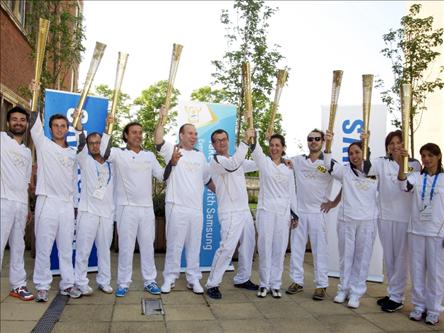
TurkishTorchbearersSamsungOman

Turkish torchbearers – image from trt.net.tr

The list in total includes:

“the soloist of Mor ve Ötesi, a music ensemble Harun Tekin, the first sportswoman who represented Turkey at the Winter Olympics Kelime Aydın Çetinkaya, national swimmer Emre Muşluoğlu, columnists Cengiz Semercioğlu and Şelale Kadak, the founder chairman of the Alternative Living Association Ercan Tutal, coordinator of the Family Association of Turkey Deniz Yılmaz Atakay, academic Deniz Nur Ural, education advisor Mustafa Çakıroğlu, cultural manager Tuna Yılmaz and university student Cem Arslan.”
The story so far – a Telegraph guest post

The following is cross-posted from the Telegraph’s new Olympics data blog:

How many stories can a set of data hold? When it comes to Olympic torchbearer data, after three weeks I’m still counting. From company bosses exchanging ‘torch kisses’ and mapping Nottinghamshire torchbearers to chief executives ignoring official advice not to take Olympic torchbearer places, the dataset is a data journalist’s dream. Continue reading

Pricing of LOCOG’s Olympic torch relay bunting beyond some councils

At least two councils hosting parts of the Olympic torch relay have not been able to buy official bunting from organisers LOCOG because of high prices – while the cost of bunting in a third local authority was quoted at five times that of road closures and stewarding equipment combined.

Both Highland Council and Iver Parish Council decided they could not justify the cost of the branded bunting, which has to be bought from the Olympic organising committee LOCOG. Continue reading

Stansted torchbearers investigated by David Morgan

A cluster of Chinese torchbearers with stories of business success have been identified by Stansted resident David Morgan.

The Herts and Essex Observer reports on his findings, and includes a reaction from LOCOG who say “the Chinese nationals were nominated through a campaign by electronics giant Samsung.” Continue reading

Public didn’t get “90%” of torchbearer places, figures reveal {updated}

Updates follow original post below

The commonly-quoted figure that 90% of torchbearer slots were “available to the public” is wrong, an analysis of official figures suggests.

According to LOCOG statistics published by ITV News, torchbearer allocations were distributed as follows:

  • “33% of places held by LOCOG (total 2,640)
  • “17% of places to each of the three Presenting Partners (total 1360 each)
  • “16% of places shared between the IOC (total 117), BOA (total 250) and other Games commercial partners (total 913).”

Based on the above numbers, commercial partner slots alone represent 11.4% of the total. Only 84% – not 90% – have been allocated to members of the public through various competitions and nomination processes. This represents 480 people who have missed out on promised slots. Organisations who are not Presenting Partners cannot allocate torchbearer slots publicly.

UPDATE (June 12, 10am): A spokesperson for London2012 confirmed the figures and adds:

“The BOA and IOC and some of the commercial partners in the 16 per cent allocation also put forward members of the public too e.g. grassroots sports coaches, athletes, long-term supporters of Games and existing customers in case of commercial partners.”

However, as only Presenting Partners can accept nominations from members of the public, it’s not clear how other commercial partners would have been able to do so.

The statement appears to contradict figures previously in documents from organisations including the BOA, which explicitly states that its own places are separate from those available to the ‘general public’:

“90% of these slots will be allocated to the general public through each [Presenting Partner] company’s own public selection process. The remaining 10% has been allocated to other deserving bodies, of which the British Olympic Association is one.”

It’s also not clear how London2012 could be confident that the extra 6% of places were “made available to the public”. We are awaiting a response explaining what processes were in place to monitor that.

UPDATE (June 12, 7pm): A further response states the following:

“90% of the 8,000 Torchbearer places are made available to the public through a number of channels, including the four public nomination campaigns from LOCOG, Coca-Cola, Lloyds TSB and Samsung.

“The 16% share is made up of core stakeholders, for example, the IOC, BOA and commercial Games partners. Some of these stakeholders could also put forward members of the public, for example, long-term supporters of the Games and sports coaches.

“The rights packages for some partners included a small number of Torchbearer places that had to be filled through internal campaigns, for example, from existing customer and staff pools.”

The spokesperson does not address the question of what processes were in place to monitor any allocation of places to ‘members of the public’ in this way.

We have asked again for clarification on that process, specifically whether LOCOG can identify the 480 members of the public who may have been given torchbearer spaces through routes other than those previously outlined.

Stoke Sentinel on Help Me Investigate: “Collaboration is king”

This Is Staffordshire’s digital publisher David Elks has written about Help Me Investigate in the Stoke Sentinel’s ‘DaviddotElks’ column following his involvement in our investigation into corporate torchbearers. He writes:

“Collaboration is such an obvious idea because it allows people to focus on their skills, but team-work doesn’t necessarily come naturally to reporters. It should.

“For the seven years that I was a business journalist at The Sentinel, there was a constant desire and pressure to find stories which would make the front page ‘splash’.

“I would be incredibly loathed to share any tip-offs or contact information if I thought another colleague might use it to break news that I could report myself.

“But I’ve had to change my attitude as I’ve moved to reporting on the web. Why?

“Because it’s almost impossible to do everything yourself.”

We delayed our post on the photo of two corporate torchbearers Tom Foley and Christos Angelides exchanging a ‘torch kiss’ to allow the newspaper to run the story first. The story was later picked up by the Daily Mail.

Daily Mail pick up our torchbearer photo story

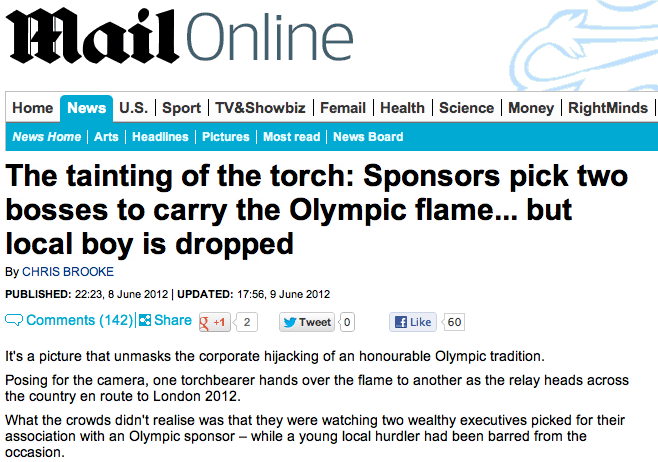
Daily Mail torchbearer story

The photo and story we published last week on the ‘torch kiss’ of two retail bosses has been picked up by the Daily Mail.

The newspaper combines the story with one previously reported in This Is Staffordshire (but not credited): that of local torchbearer James Taylor, whose place was withdrawn two weeks earlier due to ‘failing Home Office checks’, despite Taylor having no criminal record and passed CRB checks previously.

The piece suggests that Taylor’s withdrawal may be connected to the fortuitous scheduling that allowed the two bosses to carry the torch on sequential legs of the relay.

This suggestion had also been made by a parent of James Taylor in the comments to a This Is Staffordshire piece on the sponsor’s choice of torchbearer. She added:

“Having had this done on him as angered me even more, his sporting and the family’s reputation has been marked along with his broken spirit, I do hope the people who decided to do this to my son feel shame.”

It was This Is Staffordshire’s David Elks who found the image of the two corporate torchbearers when we approached him to ask if the newspaper had any images of those carrying torches through Stafford.

Torchbearers do not normally have any control over where or when they carry the torch.

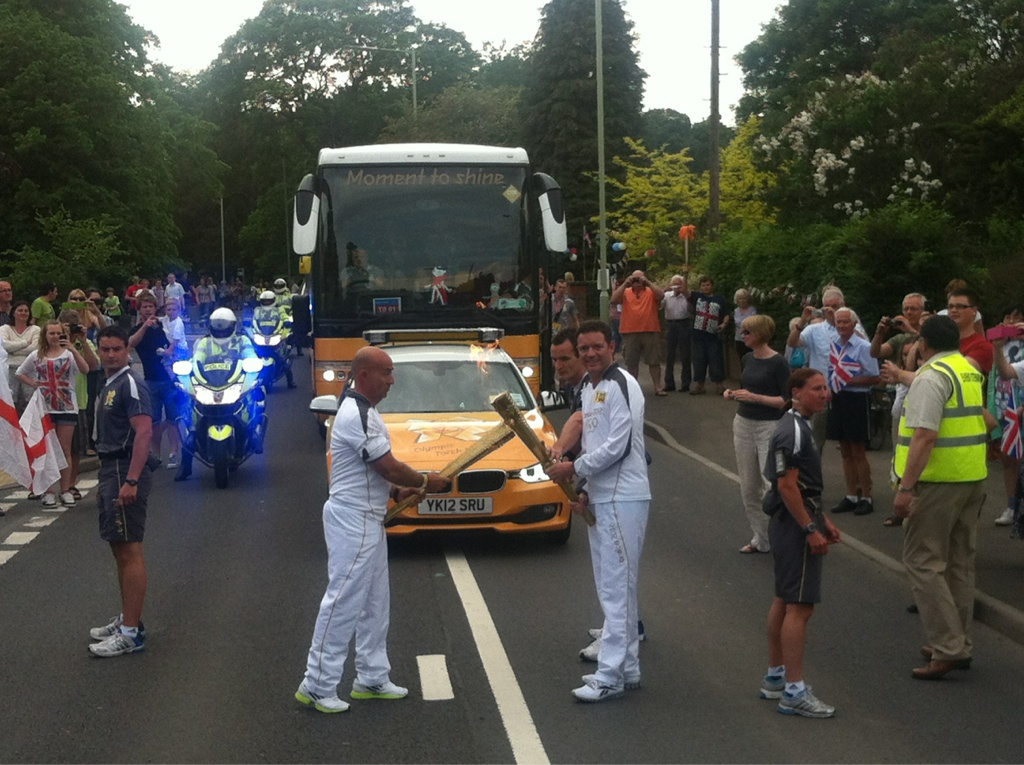
Photo: the ‘torch kiss’ of two retail bosses

Intersport general manager Tom Foley and Next's Group Product Director Christos Angelides exchange an olympic 'torch kiss'

Intersport general manager Tom Foley and Next's Group Product Director Christos Angelides exchange an olympic 'torch kiss' - photo from BBC Stoke

This appears to be the moment two retail executives exchanged an olympic ‘torch kiss’ on Wednesday as they carried the Olympic torch through Staffordshire.

As revealed previously by Help Me Investigate Olympics, and now reported in The Independent, Daily Mail and Guardian, Intersport UK general manager Tom Foley and Next’s Group Product Director Christos Angelides were nominated by adidas to carry the torch because they had been “engaged in the business of sport for a number of years”.

The moment that the flame was passed between the two men was captured and published on Twitter by BBC Stoke. Angelides was also snapped earlier by Instagram user Trovster. Thanks to This Is Staffordshire’s David Elks for pointing us to both images from the site’s liveblog. Continue reading

Olympic torchbearer investigation picked up by Guardian

Guardian cover HMI's olympic torchbearer investigation

The Guardian have now published their story on the corporate torchbearers, following a tip-off last week from Help Me Investigate the Olympics. James Ball writes:

“More than 1,200 spaces were allocated to the International Olympic Committee, the British Olympics Association, and to staff working for Games sponsors – whose picks included company directors, Russian newspaper editors, and even an official at the US’s Food and Drug Administration.”

The article generously credits HMI Olympics and adds further details, including responses from sponsors Coca Cola who say: Continue reading